
HIV/AIDS: Assessment and Treatment through an Intersectional Lens
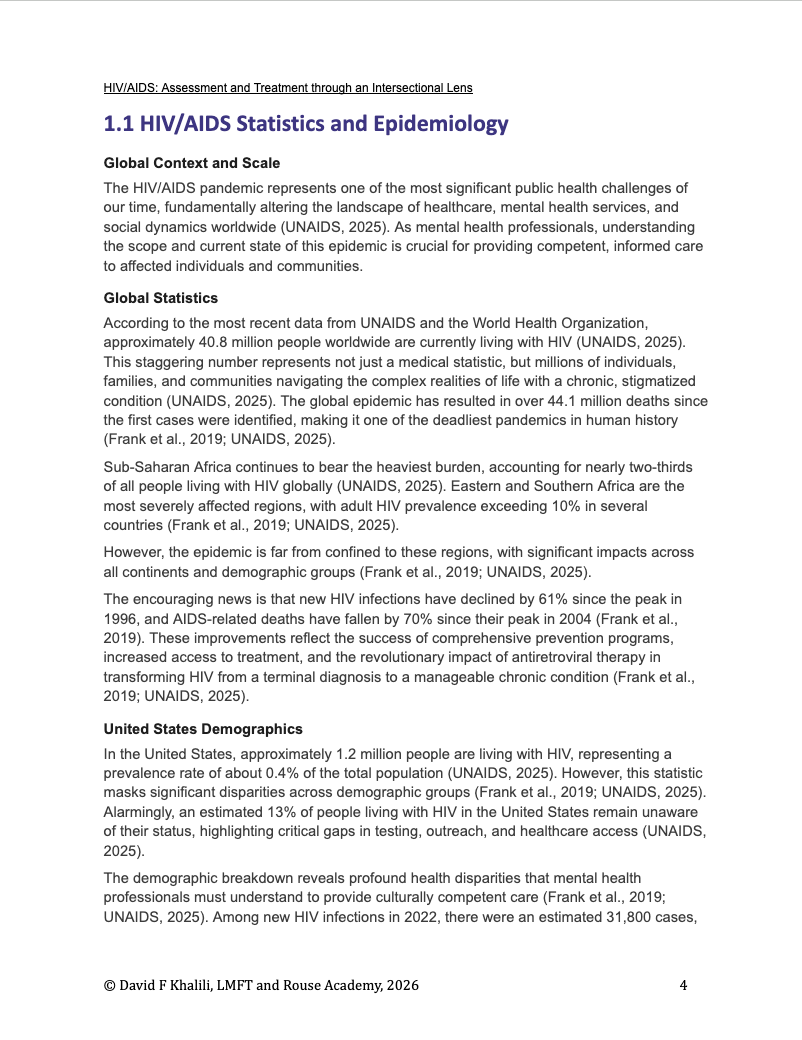
Course Syllabus:
Focus: Statistics, Evolution, Biology, Treatment, and Social Justice in California
Course Format: Text-Based Self-Study
Continuing Education Credits: 7.0 CE Credits
Course Fee: $69
Course Description
This comprehensive 7-hour course equips California mental health professionals with the essential clinical knowledge required to serve individuals and communities affected by HIV/AIDS. Participants will explore the epidemiological landscape of HIV in the United States and California, the biological foundations of the virus, and the revolutionary shift in treatment and prevention technologies such as U=U and PrEP. The course provides a deep dive into common psychological presentations, evidence-based therapeutic interventions (CBT-AD, ACT, MI), and the critical intersectional and systemic factors that shape the lived experience of marginalized populations.
Educational Goals
The primary goal of this course is to enhance the clinical competence of mental health professionals in providing evidence-based, culturally responsive care for clients living with or at risk for HIV. Specifically, the course aims to:
- Bridge Medical and Mental Health: Contextualize the impact of viral load, CD4+ counts, and ART on a client's psychological well-being.
- Advance Therapeutic Skill: Provide concrete strategies for supporting medication adherence and addressing HIV-related trauma and stigma.
- Promote Social Justice: Foster a framework of cultural humility and intersectionality to address healthcare disparities and structural racism.
Measurable Learning Objectives
By the end of this course, participants will be able to:
- Identify four key racial and ethnic disparities in HIV infection rates within the United States.
- Explain two U=U (Undetectable = Untransmittable) principles and its scientific basis for preventing sexual transmission.
- Define three aspects of the "Window Period" for different HIV testing methods, including 4th generation antigen/antibody tests.
- List three common neuropsychiatric side effects associated with different classes of antiretroviral therapy (ART).
- Describe the five stages of HIV infection, from primary infection through the AIDS diagnosis.
- Analyze the 11 "Life-Steps" (CBT-AD) protocol for integrating depression treatment with medication adherence support.
- Identify two specific legal protections for people with HIV under the Americans with Disabilities Act (ADA).
- Name the two primary transmission categories that account for over 90% of new HIV infections in the United States.
- Name the three primary HIV enzymes (reverse transcriptase, integrase, and protease) targeted by modern antiretroviral therapy.
- Identify at least three specific opportunistic infections or cancers that are classified as AIDS-defining conditions.
- List three distinct biomedical HIV prevention strategies discussed in the course (PrEP, PEP, and TasP).
- Compare the mechanisms of action for three different classes of antiretroviral drugs (e.g., NRTIs, NNRTIs, INSTIs).
- Identify at least four psychological presentations (e.g., anxiety, depression, PTSD, substance use disorders) commonly affecting people with HIV.
- Apply two core components of the Cognitive Behavioral Therapy for Adherence and Depression (CBT-AD) protocol to a clinical vignette.
- Evaluate at least two ethical considerations unique to HIV-related practice (e.g., duty to warn regarding transmission risk, confidentiality).
- Name three key structural barriers (e.g., unemployment, incarceration, lack of health insurance) that contribute to the elevated HIV risk among Black men who have sex with men (MSM).
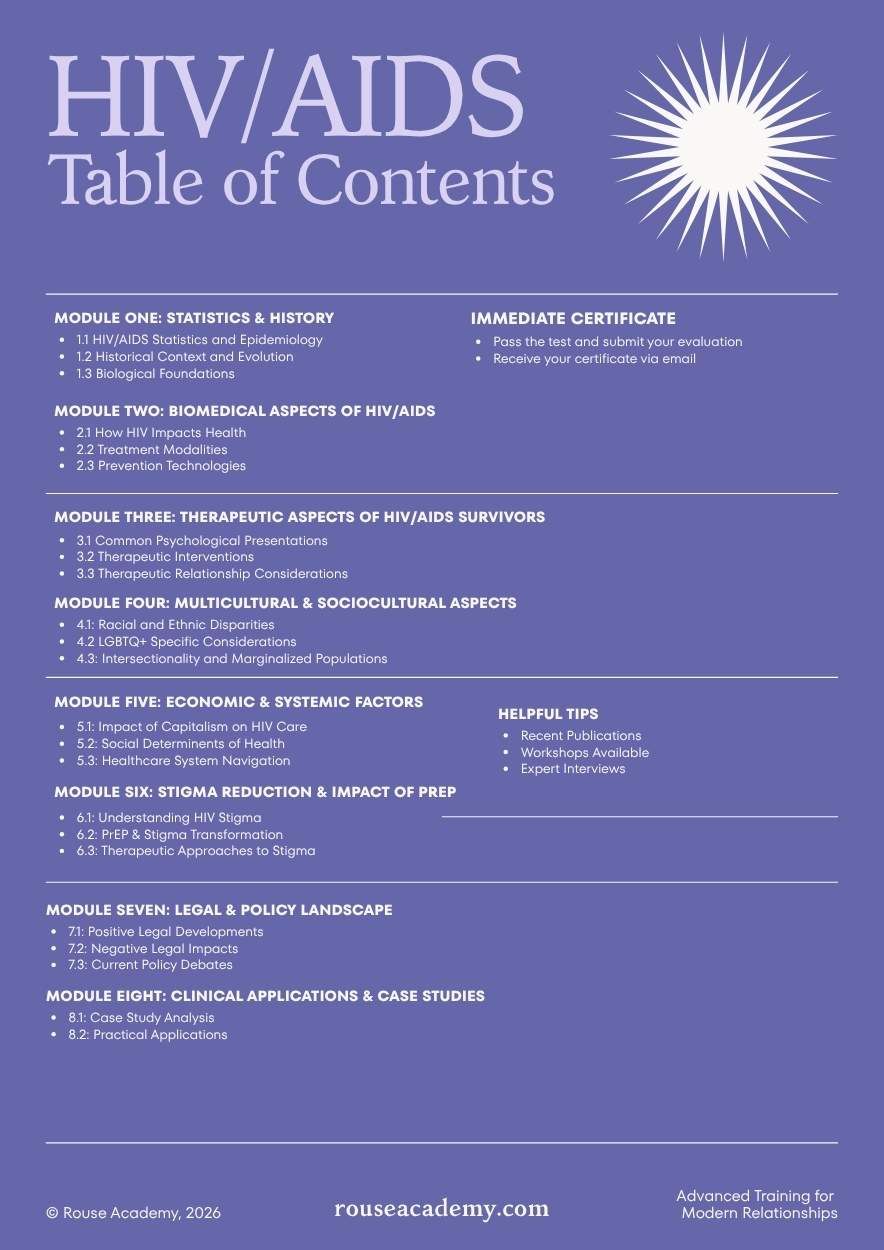
Course Content Outline
|
Topic & Module |
Duration |
Key Concepts Covered |
|
1.1 Statistics & Epidemiology |
60 min |
Global/US scale, CA specifics, and demographic disparities. |
|
1.2 Historical Context |
60 min |
Early years, the activist response (ACT UP), and the "Breakthrough Years". |
|
1.3 Biological Foundations |
60 min |
Viral structure, the infection process, and the HIV vs. AIDS continuum. |
|
2.1 Impacts on Health |
60 min |
Stages of infection, opportunistic infections, and non-AIDS complications. |
|
2.2 & 2.3 Treatment & Prevention |
60 min |
ART drug classes, Single-Tablet Regimens, $U=U$, PrEP, and PEP. |
|
3.1 & 3.2 Psychological Care |
60 min |
Anxiety, depression, complex grief, and evidence-based CBT/ACT/MI protocols. |
|
4.1 - 7.2 Social Justice & Law |
60 min |
Intersectionality, LGBTQ+ needs, structural racism, and HIV criminalization laws. |
|
Total Instructional Time |
7 Hours |
Completion Requirements
- Verification: Participants must attest to reading the full 123-page text course.
- Post-Test: A score of 70% or higher is required on a 70-question multiple-choice assessment.
- Evaluation: A course evaluation must be submitted to verify that learning objectives were met.
Instructor Qualifications
David F. Khalili, LMFT #89087
- Owner/Clinical Director: Rouse Relational Wellness.
- Expertise: Specialized training in sexuality, relationship diversity, and marginalized communities.
- Direct Experience: Training at UCSF AIDS Health Project.
- Academic Foundation: Master’s in Sexuality Studies (SFSU) and Counseling Psychology (GGU)
- Author: Sex Worriers and The Mental Health Workbook for Men.
Provider Information & Policies
- Provider: David F. Khalili, LMFT is approved by CAMFT to sponsor CE for LMFTs, LCSWs, LPCCs, and LEPs.
- CEPA Provider #: 1000132.
- Refund Policy: Full refunds are granted if the request is submitted in writing and the post-test has not been graded. No refunds for accessed content.
- Grievances: Please email concerns to david@rouse.academy.
- Accommodations: For special needs, contact David Khalili at david@rouse.academy or 415-448-6743.
