
Workshop Info:
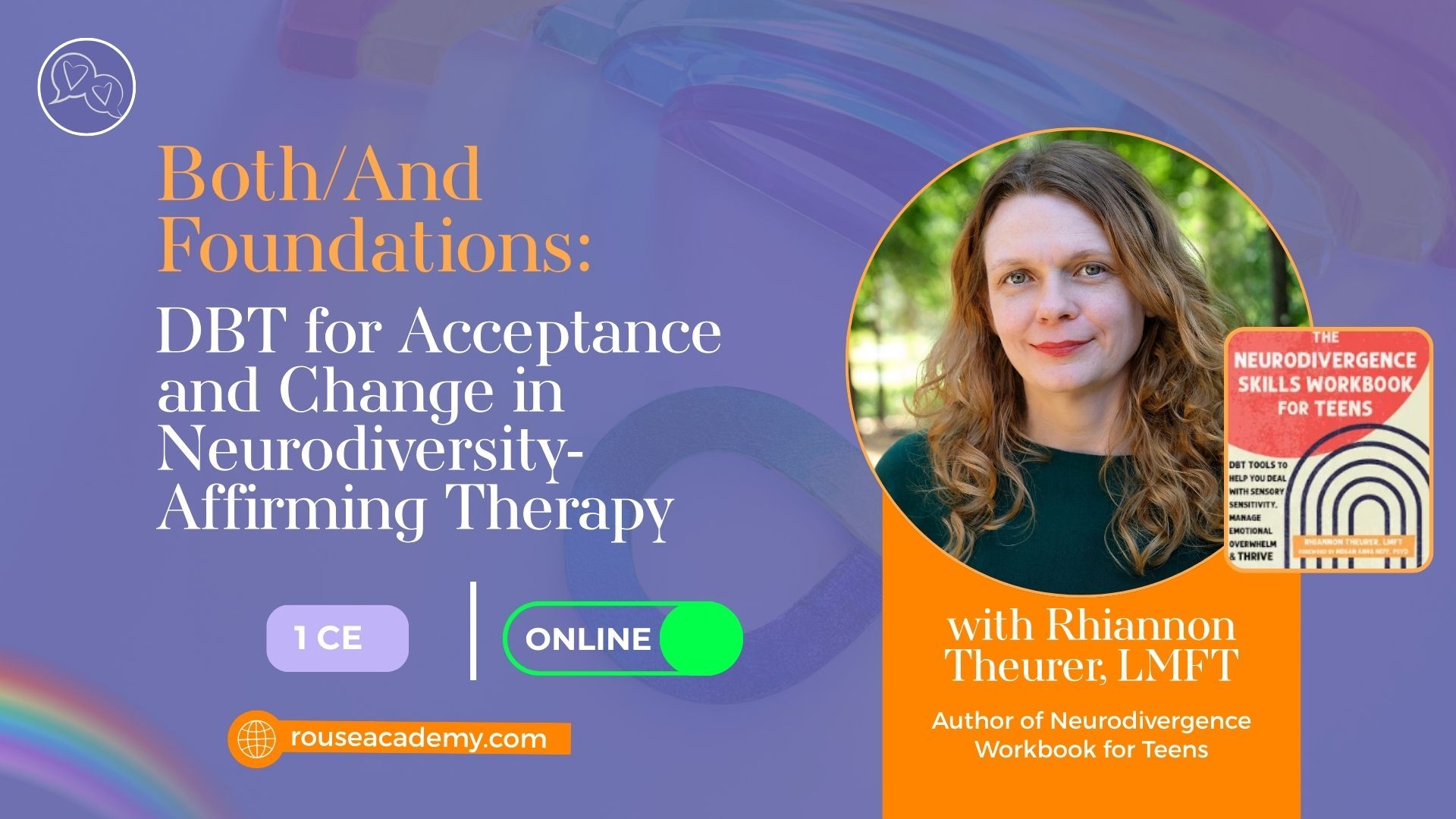
- Presenter: Rhiannon Theurer, LMFT
- Recorded date: May 29, 2026
- CEs: One (1) Continuing Education credit included
- CE Approval: Approved by CEPA #1000132, for California LMFTs, LCSWs, LPCCs, and LEPs
- Level: Introductory/Beginning - no prior knowledge of DBT or neurodivergence required
Special note:
You must subscribe at checkout to receive emails related to the event including Zoom links and course evaluations.
Course Description
The neurodiversity paradigm has been transformative for many clients and clinicians alike. Recognizing that neurodivergent individuals are not inherently broken, but rather navigating a world not designed for how their brains and nervous systems work, has offered profound relief and validation. At the same time, clinicians often find themselves caught between old models of pathology and newer affirming frameworks, uncertain about how to help clients pursue meaningful change while remaining genuinely neurodivergent-affirming.
Both/And Foundations introduces clinicians to a dialectical approach rooted in Dialectical Behavior Therapy (DBT) that holds acceptance and change simultaneously. Drawing on Linehan's dialectical framework and neurodiversity-affirming principles, this training offers practical clinical tools that can be applied across therapeutic modalities. No prior knowledge of DBT or neurodivergence is required. This course is appropriate for therapists across licensure types and practice settings who work with or are interested in working with neurodivergent clients.
This course is introductory in level. It does not assume familiarity with DBT or the neurodiversity affirming paradigm, but it goes beyond a definitional overview to offer concrete skills and case-based application.
Instructor Information
Rhiannon Theurer, LMFT (Oregon License T1196; also licensed in CA and WA), is a neurodivergent therapist in private practice in Ashland, Oregon. She works with teens and adults using DBT and narrative approaches, with a specialization in neurodivergent-affirming therapy. Rhiannon is the author of The Neurodivergence Workbook for Teens (New Harbinger, 2025). She holds a master’s degree in an area related to the subject matter and brings training, certification, and substantial clinical experience in both DBT and neurodivergent-affirming practice.
Educational Goals
This training is designed to expand clinicians’ capacity to work effectively and ethically with neurodivergent clients by integrating a dialectical perspective into affirming clinical practice. Participants will develop a foundational understanding of dialectics and their application to the tensions inherent in neurodivergent-affirming change work. Clinicians will leave with greater confidence in walking the middle path — validating neurodivergent identity and experience while supporting clients in pursuing goals that are meaningful to them.
Specifically, this course aims to:
- Build familiarity with the dialectical worldview and its relevance to neurodivergent-affirming therapy
- Introduce DBT-informed skills that support both acceptance and goal-directed change
- Strengthen clinicians’ ability to conceptualize and hold the social and cultural context shaping neurodivergent clients’ self-perceptions
- Increase clinician confidence in supporting client change without pathologizing neurodivergent identity
Measurable Learning Objectives
At the conclusion of this training, participants will be able to:
- Explain what dialectics are and apply dialectical thinking to at least two specific clinical challenges commonly faced by neurodivergent clients
- Describe at least three social and cultural factors that influence neurodivergent clients’ views of self, including the impact of societal norms that pathologize neurodivergence
- Apply four DBT-informed skills — radical acceptance, effectiveness, values clarification, and interpersonal effectiveness goal-setting — to support neurodivergent clients in making desired changes
- Distinguish between therapist behaviors that reinforce pathologizing frameworks and those that reflect neurodivergent-affirming practice, using case examples to illustrate the difference
References
The following references are submitted in APA 7th edition format and correspond directly to the learning objectives and course content:
Linehan, M. M. (2015a). DBT skills training handouts and worksheets. The Guilford Press.
Linehan, M. M. (2015b). DBT skills training manual (2nd ed.). The Guilford Press.
Theurer, R. (2025). The neurodivergence workbook for teens. New Harbinger.
Wise, S. J. (2026). The neurodivergent friendly workbook of DBT skills (2nd ed.). Lived Experience Educator.
Policies
Attendance and Credit
Participants must attend the course in its entirety to receive CE credit. Attendance will be verified via Zoom registration and sign-in/sign-out log. Participants who arrive late or leave early will not receive credit for the session.
Evaluations
All participants must complete the course evaluation in order to receive their Certificate of Course Completion. Evaluations assess achievement of the learning objectives and inform ongoing quality improvement.
Certificates of Completion
Certificates will be issued digitally within 5 business days of course completion and evaluation submission. For duplicate certificate requests, contact Rouse Academy at david@rouse.academy
Grievance Policy
Participants who have concerns about the course may submit a grievance in writing to Rouse Academy at 4124 18th St, San Francisco, CA 94114, or by email at david@rouse.academy. Grievances will be acknowledged within 5 business days and resolved within 30 days.
Refund and Cancellation Policy
Refunds will be issued in full if requested prior to the start of the course. No refunds will be issued after course materials have been accessed or the live session has begun. Refunds will be processed within 7 business days to the original payment method.
Disability Accommodations
Rouse Academy is committed to ensuring full access for all participants. Accommodation requests should be submitted at least 5 business days prior to the course date. Contact David F. Khalili, LMFT at 415-448-6743 or david@rouse.academy.
