November 11–13

FREE to Attend

Online + In-Person

10+ CEs, Resources & Recording Add-Ons
You know the moment


Your client is mid-disclosure about the AI they talk to every night, about a bond that feels realer than most of their human ones, about the app on a new toy that may know more than they realized, and you’re reaching for a framework that isn’t there.
You’ve sat through trainings that were technically about AI and trainings on sex therapy, but rarely on the place where the two meet. You wanted clear answers: what to ask, what the law and your board expect, what to actually say in the room. You wanted the training your clients’ reality calls for.
This is that training.
Three days. Researchers from the Kinsey Institute, psychosis specialists from UCSF, leaders in sextech, and a deep dive into the law and ethics of AI in practice. Free to attend live.
Why this summit
At Rouse Academy, we believe understanding today's tech isn't optional anymore. Your clients are already living with it, whether or not you feel ready. This isn't about replacing the human touch; it's about knowing where it still matters most, and where AI is already reshaping desire, connection, and risk in ways the research, and the law, are still catching up to.
We'll dive into: what state and federal guidelines say about using AI in our practice, how AI agents are becoming a 3am confidant for some clients and a clinical red flag for others, and where synthetic intimacy is raising questions nobody's fully answered yet.

Concrete interventions
you can bring into session immediately

In-session scripts
for the moments that usually leave clinicians fumbling

Clinical frameworks
for AI-Companions, psychosis, data security, and safety that hold up across case types

Optional add-on
10 CE hours for California LMFTs, LCSWs, and LPCCs
Lifetime access to recordings
November
11-13
Format
Live online (both days)
Cost
Free to watch live
CE Credit add-on
10 CE hours for CA LMFTs, LCSWs, LPCCs
Full Access Bundle
$149 add-on: includes all session recordings, the resource booklet, and lifetime access
Can't make it live? The $149 recording bundle means you never lose access to the scripts, slides, and takeaways — even if session conflicts pull you away on the day.
Event Overview
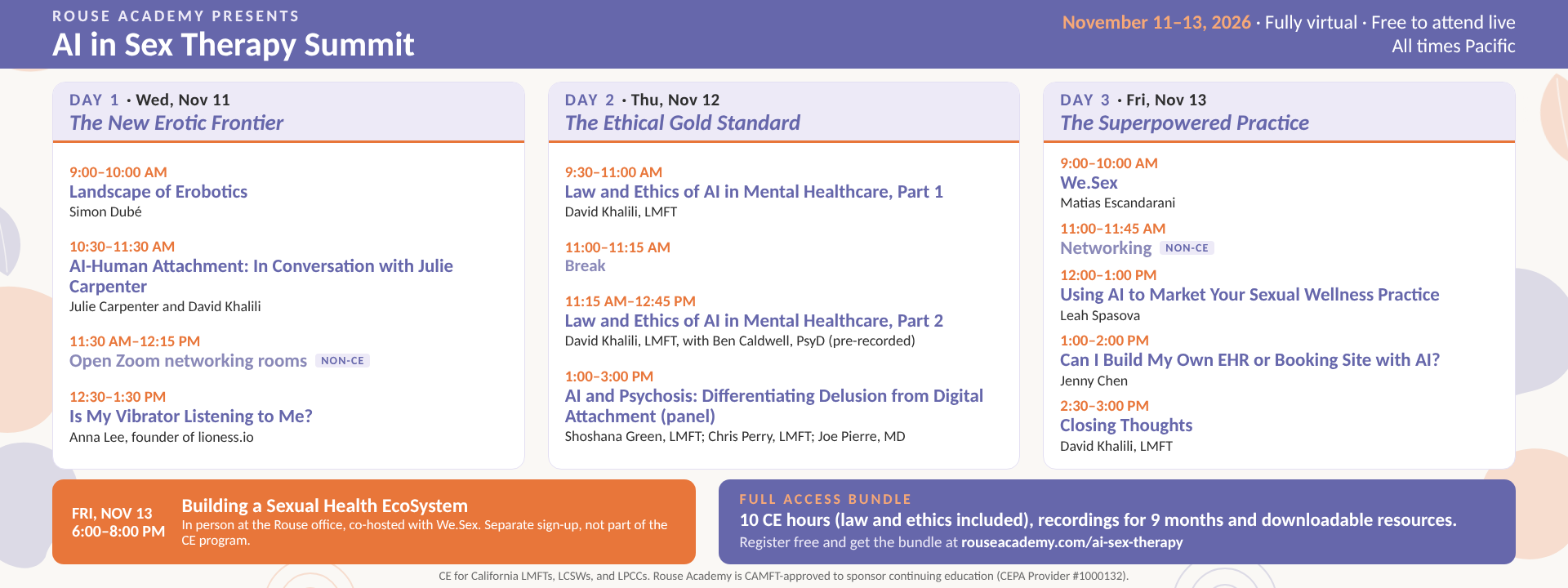
THE LINEUP: Day One
Day One, Session 1
Erobotics: From emerging technologies to research and clinical applications

November 11, 9:00 AM PST · 60 minutes · 1 CE hours (add-on)
Rapid advances in robotics, mixed realities, and artificial intelligence (AI) are transforming how individuals experience intimate and sexual relationships. These technologies are reshaping our desires, partner preferences, and sexual and relational configurations, requiring scientific and clinical practices in sexology to adapt rapidly. This presentation will explore the implications of this techno-erotic revolution, as well as the challenges and opportunities it presents for research and clinical practice in the age of erobotics.

Learning Objectives
-
The landscape of Erobotics: Examine three aspects of emerging technologies, trends, and their implications for human sexuality and relationships.
-
Research in erobotics: Previous research, four key findings, and important future research directions.
-
Clinical applications of Erobotics: Three scientific examples of how to leverage emerging technologies to improve clinical assessment and interventions in sexology.
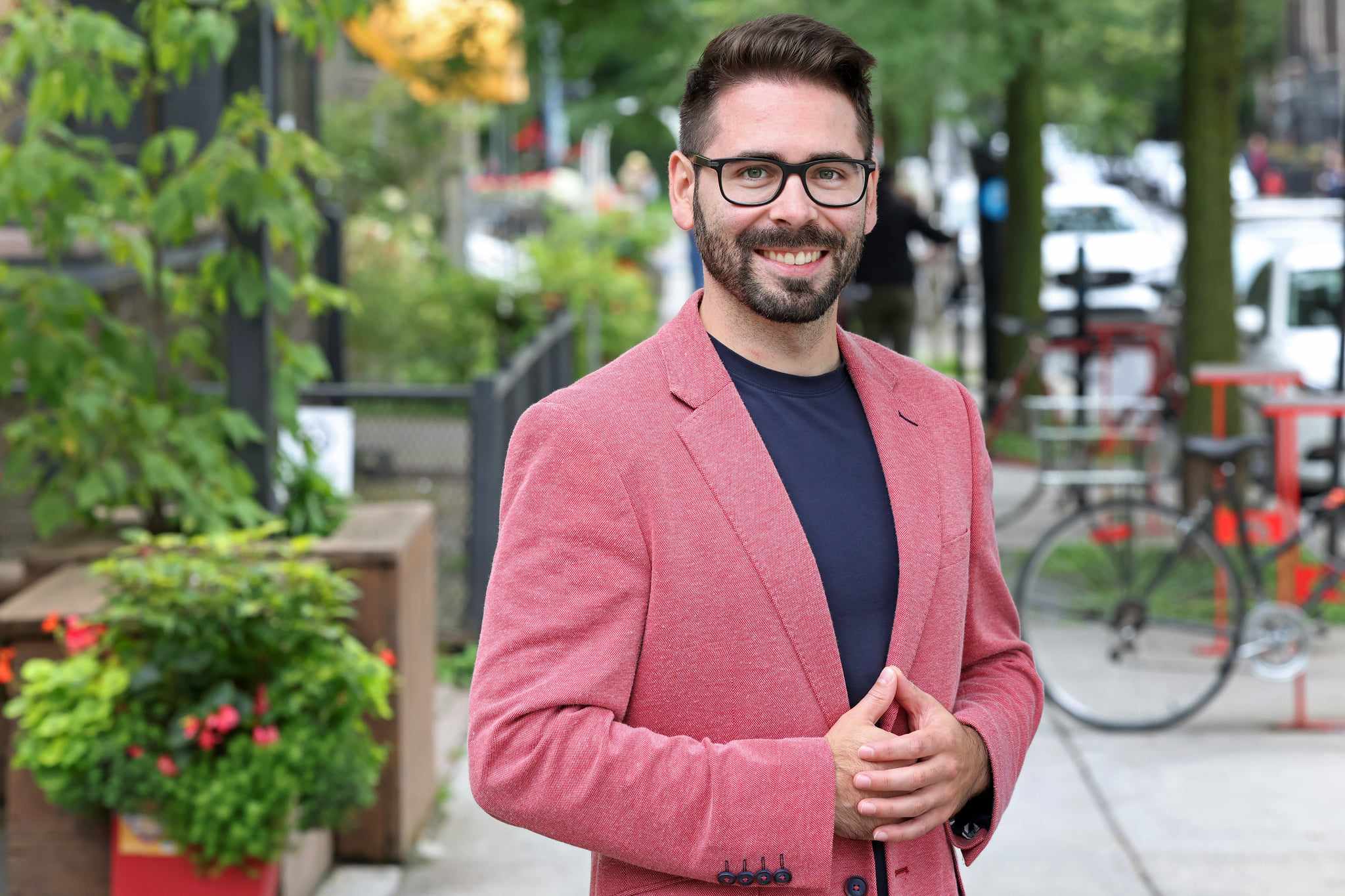
Day One, Session 2
Attached to AI: In Conversation with Julie Carpenter, PhD
November 11, 10:30 AM PST · 60 minutes · 1 CE hour (add-on)
Julie Carpenter, PhD, researches human-AI interaction and trust. In conversation with David Khalili, she explores how attachment to an AI forms, what trust-building with a non-human entity looks like, and what it means for the person sitting across from you.
Learning Objectives
- Describe three factors that contribute to the formation of attachment and trust between a person and an AI companion.
- Explain two ways attachment to an AI companion may resemble, and two ways it may differ from, attachment to a human partner.
- Apply three exploratory questions to a client’s description of their AI companion relationship to assess what it provides and what concerns it may raise.
Day One, Session 3
Networking
November 11, 12:00 PM PST · 45 minutes · No CE hour, not recorded
During our break we'll go through some light ice breakers to get to know each other and share contact information for future referrals and collaborations.
Learning Objectives
- You'll find two truths and one lie about your colleagues (sorry, bad CE humor. No continuing education credits will be included)

Day One, Session 4
Is My Vibrator Listening to Me?
Nov 11, 12:30 PM PST · 60 minutes · 1 CE hour (add-on)
Anna Lee is a co-founder of Lioness, the smart vibrator. In “Is My Vibrator Listening to Me?” she’ll explain how Lioness uses AI with its data to expand what we know about sexual pleasure, and where she sees AI and sextech heading next. You’ll get an insider’s view of what connected intimacy tech collects, what it learns, and what that means for the clients you see.
Disclosure: Anna Lee is a co-founder of Lioness, a commercial product.
Learning Objectives
- Identify three types of data that connected sextech devices, such as smart vibrators, may collect, and describe how AI can be used with that data to expand knowledge about sexual pleasure.
- Describe three current trends in how AI is being used in sextech, and explain one way each may shape what clients bring to therapy.
- Apply an understanding of how connected devices handle intimate data to respond to a client’s question about privacy, such as “Is my vibrator listening to me?”

THE TAKEAWAY
You didn't get into this work to hand clients a pamphlet and hope for the best. You got into it to actually help in the room, in the moment, with something real to offer when a client looks at you and says "I don't know what's wrong with me."
This summit exists so you never have to improvise that answer again.
Rouse Academy is approved by the California Association of Marriage and Family Therapists (CAMFT) to sponsor continuing education for LMFTs, LCSWs, LPCCs, and LEPs. CEPA Provider #1000132.
THE LINEUP: Day Two
Day Two, Session 1
Law & Ethics of AI in Mental Healthcare
November 12, 9:00 AM PST · 180 minutes · 3 Law and Ethics CE hours (add-on)
Drawing from cutting-edge AI research and clinical applications, participants will examine current AI tools in therapeutic practice, emerging regulatory frameworks, and evidence-based strategies for protecting client welfare while leveraging AI innovations responsibly. Through real-world case studies and California-specific legislation analysis, therapists will develop practical competencies to navigate AI-related ethical dilemmas that arise in direct client care. By the end of this training, participants will be equipped to implement AI tools that enhance rather than compromise therapeutic relationships, ensuring client safety, privacy, and treatment efficacy remain paramount.
Learning Objectives
- Describe at least three main ways that AI is being applied in mental health therapy.
- Identify three pieces of current California legislation directly related to AI in mental healthcare.
- List four examples of AI-driven therapy tools.
- Explain how AI-powered chatbots have evolved from simple rule-based systems to at least three advanced models using NLP.
- Discuss three challenges that persist when developing and implementing AI solutions for clinical documentation.
- State two examples of information therapists may disclose without consent in order to protect the patient or public from harm.
- List five principles of AI ethics code currently in review by CAMFT
- Identify at least four factors for vetting AI vendors.
- Summarize three practical recommendations for practitioners to protect sensitive client data when using AI tools.

Day Two, Session 2
AI Psychosis
You've seen the headlines about "AI psychosis." Maybe a client has already walked in with a version of the story.
Here's where the science actually is: early. Nobody can yet say whether AI causes psychosis, amplifies a vulnerability that was already there, or is simply the newest thing to show up inside delusional content, the way radio and television did before it. Anyone who tells you they're certain is ahead of the evidence.
What we do know is that you're not starting from zero. Assessing psychosis, and treating it, are skills many of you already have. The open question is what, if anything, changes when the thing reflecting a client's beliefs back to them is a chatbot that's available at 3 a.m. and rarely pushes back.
Featuring Shoshana Green, LMFT, Joe Pierre, MD, and Chris Perry, LMFT
Learning Objectives
- Coming soon


Who is this for
Licensed and registered mental health clinicians (LMFT, LCSW, LPCC, and associates) who want to work more effectively, and more confidently, with emerging trends related to artificial intelligence's impact on sex, dating, and relationships.
Whether you have years of vibe coding practice under your belt or you're just starting to get cautiously curious, this summit meets you where you are and gets you further.
THE LINEUP: Day Three
Day Three, Session 1
Building Apps for Sexual Wellness
November 13, 9:00 PM PST · 60 minutes · 1 CE hours (add-on)
Matías Escandarani is the founder of WeSex (We.Sex), a sexual wellness app and community built around programs and content from sexual health professionals. In this session he’ll share his experience building the platform and its AI sex coach, including lessons learned along the way. You’ll get an insider’s view of how sextech gets built, and of the tools your clients may already be turning to.
Disclosure: Matías Escandarani is the founder of WeSex, a commercial product.
Learning Objectives
- Describe three key steps in building a sexual wellness platform that includes an AI sex coach, and identify one clinical or ethical consideration at each step.
- Identify three ways clients may use AI-based sex coaching tools, and explain two potential benefits and two potential limitations of these tools for clients’ sexual wellness.
- Apply what they’ve learned about how AI sex coaching tools work to discuss a client’s use of one with them, including when to encourage it and when to recommend professional support.

Day Three, Session 2
Using AI to Market Your Sexual Wellness Practice
Nov 13, 10:30 AM PST · 60 minutes · 1 CE hour (add-on)
Leah Spasova runs LifeSexperts, a sex, intimacy, and relationship practice based in the UK. In this Day 3 session she’ll show you how to leverage AI to market your practice, from reaching the clients you most want to work with to getting your message out. You’ll leave with practical ways to put AI to work for your practice’s visibility.
Learning Objectives
- Identify three ways AI tools can support marketing a therapy practice, and describe one benefit and one limitation of each.
- Describe two ethical or legal considerations, such as accuracy of claims, client confidentiality, and advertising standards for licensed clinicians, that apply when using AI to create marketing materials.
- Apply a review process to an AI-generated marketing piece, evaluating it for accuracy, tone, and compliance before publishing.

Day Three, Session 3
A clinic, reimagined
Nov 13, 1 PM PST · 60 minutes · 1 CE hour (add-on)
After 11 years running a marketing agency and working with over 200 D2C brands in fashion and luxury, Jenny Chen turned her focus to marketing for Puzzle Acupuncture, the San Francisco clinic run by her wife, Dr. Deb Ma. Through a podcast, content, and tools she built for the practice, she helped triple the clinic's bookings in three months. She uses AI to build everything from booking and CRM tools to interactive animations that express the clinic's personality. Her talk draws on that experience to show exactly where AI helped, what didn't work, and how much fun a small practice can have making things of its own.
Learning Objectives
- Describe how a small practice can use AI to build its own booking and CRM tools, with a walkthrough of what we built for Puzzle.
- Explain how we connected our podcast and website content to the booking journey, and what we tracked as bookings grew.
- Identify what was useful and what fell short in our chatbot and search experiments, using real examples from the clinic.
- Explore how a solo practitioner can use AI-assisted coding to express their personality through a website, animation, or small interactive experience, including our playable Halloween page.

THE TAKEAWAY
You didn't get into this work to hand clients a pamphlet and hope for the best. You got into it to actually help in the room, in the moment, with something real to offer when a client looks at you and says "I don't know what's wrong with me."
This summit exists so you never have to improvise that answer again.
Rouse Academy is approved by the California Association of Marriage and Family Therapists (CAMFT) to sponsor continuing education for LMFTs, LCSWs, LPCCs, and LEPs. CEPA Provider #1000132.